Featured

Catholic professor emeritus Robert Hickson dies at 80


Robert was Professor and Chairman of the Literature and Latin Department at Christendom College for seven years before returning to Military and Strategic-Cultural Studies.

Featured ImageRobert Hickson, Jr. Maike Hickson


Maike Hickson

Updated with link to the Requiem Mass (below).

FRONT ROYAL, Virginia — Robert David Hickson, Jr., of Front Royal, Virginia died at his home on September 2, 2023, at 21:29 PM after several months of suffering and after having received the last rites of the Catholic Church. He was surrounded by friends and family.

Robert is survived by me—his wife Maike, his eight children with first wife Sharon (Mary Pat Smey [Robert]; Elizabeth Frappier; Kristin Uhlenkott [Paul]; Bridget; Anna-Sofie; Peter [Melissa]; David [Linda]; and Erik [Kaitlyn]), our two children (Isabella and Robert), his 27 grandchildren, his brother Ronald and sister-in-law Louise, and their three children (Karl, Laura, and Joseph).

My husband was born during a snowstorm on December 29, 1942, in Baltimore, Maryland and raised by his beloved mother Muriel Agnes in Margate City, New Jersey. He, his mother, and his younger brother Ronald Hall endured the loss of his little “Irish twin” brother, Richard Arnold.

Robert grew up by the Atlantic Ocean, attending Atlantic City High School, and was a passionate lifeguard and surfer as well as an accomplished athlete. He graduated from United States Military Academy West Point in June 1964 and was assigned to Southeast Asia. After a year, he became a U.S. Army Special Forces Officer and earned his “3-prefix” as a Green Beret, having already completed Parachute School and Ranger School and certain forms of Naval Commando training.

After tours in Vietnam and elsewhere in Asia, Robert taught at the J.F. Kennedy Special Warfare Center in North Carolina as the Head of the East Asian Seminar and Instructor in Military History and Irregular Warfare.

He acquired his Ph.D. in Comparative Literature and Classics (Greco-Roman) at the University of North Carolina at Chapel Hill, with an emphasis on Ancient Philosophy and Medieval Literature (including theological texts).

In the 1980s, Robert was Professor and Chairman of the Literature and Latin Department at Christendom College for seven years before returning to Military and Strategic-Cultural Studies. He became a professor at the Joint Military Intelligence College (former Defense Intelligence College), a graduate school in the U.S. Intelligence Community at the Defense Intelligence Agency (D.I.A.) in Washington, D.C. He taught Foreign Area and National Security Studies, Military History and Strategy, Moral Philosophy and other subjects.

Robert was then invited to the Air Force Academy for four years as a Professor in the William Simon Chair of Strategy and Culture, teaching in several academic departments. He concluded his Federal Service as a Professor of Strategic and Cultural Studies, as well as Military History and National Security Studies, at the Joint Special Operations University in Florida, a part of the U.S. Special Operations Command.

Comparative cultural and strategic-historical studies constituted a unifying theme in these various forms of teaching over the years.

My husband’s life was permeated by his Catholic faith, which he shared with many people. With his passion for Christ, he touched many lives, helped many to enter the Catholic Church, defended Catholic doctrine, and drew Catholics deeper into the faith by presenting, over the course of 40 years, good Catholic literature from all over the world. He brought me into the Catholic Church, something for which I will be eternally grateful. He taught me to pray the rosary.

He was a man of learning and of laughter, full of life and energy.

Robert was so dedicated to the defense of life he helped to edit, in an influential manner, an important Life Bill under President Ronald Reagan. Children were always so close to my husband’s heart. He often said, with tears in his eyes, that the hardest thing for him in Vietnam was seeing the suffering—and even the deaths—of children. Robert loved babies and often said in conversations, “Let us not forget the little ones.”

Late in life, Robert taught his youngest two children how to read, sitting down with them every day and going through the reading material. He read to them—and me—for hours in the winter months, and thus Isabella and Robby knew Odysseus and Aeneas from an early age. They also learned to recite the poems of Hilaire Belloc.

Maike, Robert, Isabella, and Robby

Robert asked that we put on his gravestone the following quote from French Catholic novelist Georges Bernanos: “Blessed be he who has saved a child’s heart from despair.”

In the end of his life, stricken with dementia, he became like a child.

My husband adhered to the Faith of all Ages. He rejected the drastic changes within the Church during and after the Second Vatican Council and stayed true to Christ’s teaching. He did not care for human respect; it was what Christ thought that counted.

God gave Robert many gifts. He was the strongest man, physically and intellectually, I ever met, an opinion shared, I discovered, by one of his boyhood friends. But Robert used these gifts solely in the service of the truth. He was one of the few intellectuals in this country who did not bend his mind and argument to fit the narrative of the moment. His deep learning rooted him in eternal truth and wisdom.

Practically, that meant that Robert preferred to remain isolated in many Catholic circles rather than to praise developments out of Rome that went contrary to 2,000 years of the Church’s traditions.

It also meant that he, then a professor at the Joint Special Operations University in Florida, opposed the plan to invade Iraq and questioned the then-flourishing concepts of nation-building in Muslim countries and of the global “War on Terror.” (He would say, “How can one have a war on a method?”)

“What are the war aims and the peace aims?” he kept asking generals, strategists, and other military personnel during those early years. Had our country listened to him, our sons and the civilians of such countries as Iraq, as well as of our nation, would have been spared much suffering and death.

I am proud of my husband for taking his stance when it was not fashionable to oppose the war drums.

He also, in the 1990s, warned his country against the development and use of bioweapons. He was crucial in raising awareness among the military about bioweapons used in food crops.

I am not aware that Robert Hickson ever had to correct his writings. He had nothing to recant. He stayed the course. He fought the good fight. He was a moral conscience to his country, based on the firm convictions of his Catholic faith and his belief in the Incarnation of Christ and all that flows from it.

God has a human face. And that face suffered for us.

It is of special importance to us as a family that God allowed Robert in his final weeks on this earthly life to be so weakened in his mind that his face, too, suffered. He repeatedly, in his last weeks, covered his face with a cloth. This brought tears into my eyes because I had prayed every day a prayer for my husband’s holy death, offering up to God the Father the Holy Face of Jesus.

This great mind and intellect, with all of his physical beauty and strength, was in the end reduced to his heart. Despite his late dementia, Robert always responded to someone reaching out with his heart. He squeezed hands, smiled, blessed, prayed, and said, “Thank you” and “God bless you.” It was a truly inspiring witness of his faith, but even more so an example of God’s goodness. God wanted to teach us about the importance of the heart, of His own Sacred Heart who loved us so much that He died for us.

Robert died on a First Saturday, wearing the Brown Scapular of Our Lady of Mount Carmel. He had prayed the Rosary loyally and after periods of illness caught up on the missed decades later. I always knew that Our Lady would be at his side in his moment of death.

My husband died under a painting of the deathbed of St. Joseph. In the portrait, Joseph has Jesus and Mary at his side, and Jesus is pointing up towards heaven to God the Father and God the Holy Ghost.

We as his family deeply hope that when Robert died, he was surrounded by the Holy Trinity and the Holy Family. Requiescat in pace.

We derive great consolation from the fact that three priests were at his side on his day of death, and that numerous families and friends had stopped by to say good-bye. It was truly an inspiring holy death.

Thank you, Robert, for everything you have been and for everything you have given us. We love you, and we miss you!

The Visitation will be held on Friday, September 8 from 5:00 PM until 7:00 PM at the Enders and Shirley Funeral Home on 1050 West Main Street, Berryville, VA 22611. The Mass of Christian Burial will offered on Saturday, September 9 at 11 AM at St. Thomas Aquinas Seminary, 1208 Archbishop Lefebvre Avenue, Dillwyn, VA, 23936. We will follow in procession to the St. Thomas Aquinas Seminary Cemetery immediately following the Mass.

Flowers are welcome. If mourners prefer, they can send donations in Robert Hickson’s honor to Thomas Aquinas Seminary. The burial will be followed by a lunch reception to which all are welcome. So that we may provide enough refreshments for all mourners, please RSVP here

Readers are welcome to join in prayers at Saturday’s 11 AM Requiem here:

Maike Hickson and Family

Reprinted with the permission of LifeSiteNews.com
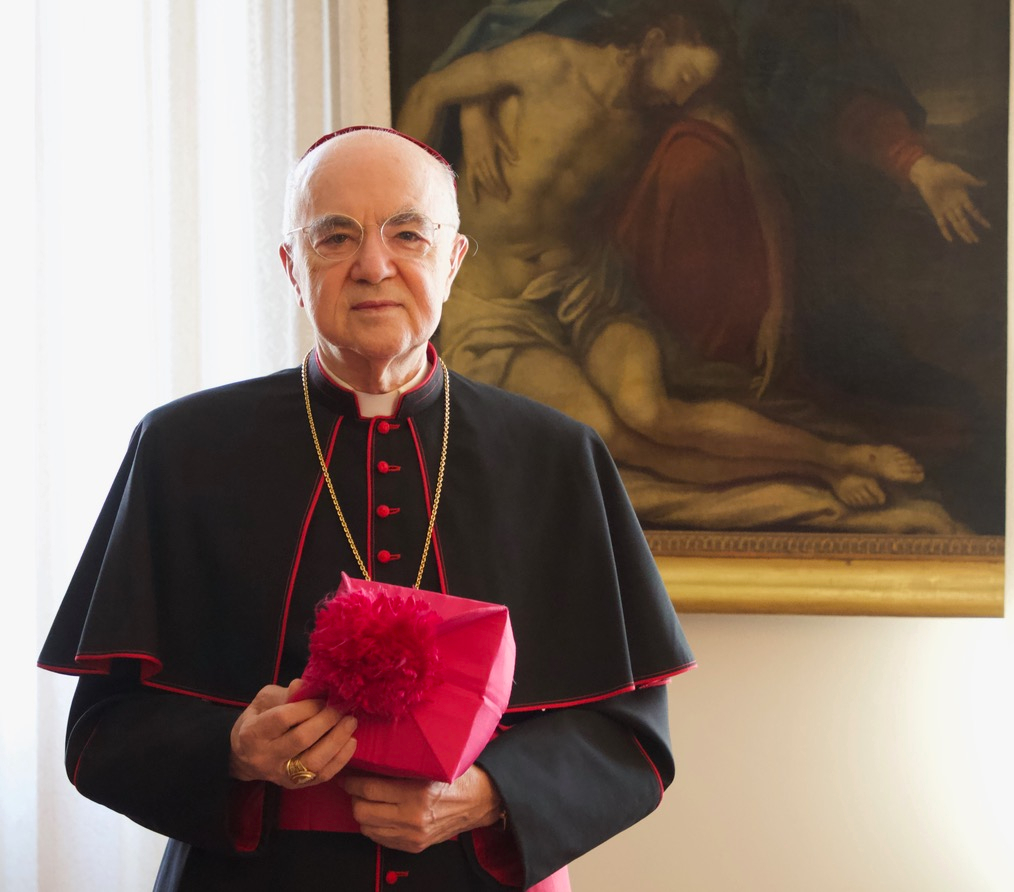
Archbishop Viganò: Restore Christianity with Good Literature

Note: this essay has first been published at LifeSiteNews.com and is re-printed here with kind permission.

by Dr. Maike Hickson

Archbishop Carlo Maria Viganò has recently written a preface for a book, Gratitude, Contemplation, and the Sacramental Worth of Catholic Literature, a collection of essays written by my husband Dr. Robert Hickson over the course of several decades. Being a distillation of his life work, this new book aims at presenting to the readers a whole set of inspiring books – most of them Catholic – that can help us restore a Catholic memory. That is to say, these books can help us revive a sense of Catholicity that comes to us from time periods and regions where the Catholic faith was an integral part of the state and society, from a lived faith.

We are very grateful to Archbishop Viganò for his preface, which highlights the importance of culture – and importantly, literature – for the revival of Christianity, and therefore we decided to publish it here (see full text below). His comments aim at turning our minds to the future, preparing the ground for a time where Christ again will reign in the heart and minds of man. His preface is therefore a sort of manifesto of faith and hope, and a wonderful instruction for us on how to go about preparing the ground for Christ.

The Italian prelate and courageous defender of the faith points to the importance of having a memory of our Catholic culture. “Memory,” he writes, “is a fundamental element of a people’s identity, civilization and culture: a society without memory, whose patrimony consists solely of a present without a past, is condemned to have no future. It is alarming that this loss of collective memory affects not only Christian nations but also seriously afflicts the Catholic Church herself and, consequently, Catholics.” The lack of culture among Catholics today, he adds, is “not the result of chance, but of systematic work on the part of those who, as enemies of the True, Good and Beautiful, must erase any ray of these divine attributes from even the most marginal aspects of social life, from our idioms, from memories of our childhood and from the stories of our grandparents.”

Describing this cultural tabula rasa that has taken place among Catholics, Archbishop Viganò goes on to say that “Reading the pages of Dante, Manzoni or one of the great Christian writers of the past, many Catholics can no longer grasp the moral and transcendent sense of a culture that is no longer their common heritage, a jealously guarded legacy, the deep root of a robust plant full of fruit.”

On the contrary, he explains, “in its place we have a bundle of the confused rubbish of the myths of the Revolution, the dusty Masonic ideological repertoire, and the iconography of a supposed freedom won by the guillotine, along with the persecution of the Church, the martyrdom of Catholics in Mexico and Spain, the end of the tyranny of Kings and Popes and the triumph of bankers and usurers.”

Archbishop Viganò clearly shows us that he understands the concept of a “cultural revolution” as developed by the Communist philosopher Antonio Gramsci, who aimed at winning the minds of the people by influencing and dominating their culture.

This cultural – and with it spiritual – empoverishment among Catholics, according to the prelate, “has found significant encouragement also among those who, within the Catholic Church, have erased 2,000 years of the inestimable patrimony of faith, spirituality and art, beginning with a wretched sense of inferiority instilled in the faithful even by the hierarchy since Vatican II.” It was the very hierarchy of the Church – together with many simpler clergymen – who helped promote such a devastation of the art within the realm of the Catholic Church. Let us only think of the modern churches, altars, and of modern church music!

With powerful words, Archbishop Viganò describes how this destruction is ultimately aimed at God Himself: “Certainly, behind this induced amnesia, there is a Trinitarian heresy. And where the Deceiver lurks, the eternal Truth of God must be obscured in order to make room for the lie, the betrayal of reality, the denial of the past.” In light of this analysis, it nearly seems to be a counter-revolutionary act to revive Catholic literature, Catholic music, Catholic architecture.

Explains the prelate: “Rediscovering memory, even in literature, is a meritorious and necessary work for the restoration of Christianity, a restoration that is needed today more than ever if we want to entrust to our children a legacy to be preserved and handed down as a tangible sign of God’s intervention in the history of the human race.”

It is in this context that he kindly mentions the “meritorious work” of this new book, praising its “noble purpose of restoring Catholic memory, bringing it back to its ancient splendor, that is, the substance of a harmonious and organic past that has grown and still lives today.” He adds that “Robert Hickson rightly shows us, in the restoration of memory, the way to rediscover the shared faith that shapes the traits of a shared Catholic culture.”

Dr. Hickson’s new book was published last month and contains 25 essays on many different Catholic authors, such as Hilaire Belloc, G.K. Chesterton, Maurice Baring, Evelyn Waugh, Josef Pieper, George Bernanos, Ernest Psichari, Father John Hardon, S.J., L. Brent Bozell Jr., and, last but not least, the Orthodox Christian authors Fyodor Dostoyevsky and Aleksandr Solzhenitsyn. The themes of this book are war and peace, justice, the Catholic vow, saints, friendship, chivalry, martyrdom and sacrifice, just to name a few. The essays of the book were written from 1982 until 2017, the first being an essay where Hickson developed the concept of “sacramental literature” and the importance of “restoring a Catholic memory.” Anthony S. Fraser, the son of the famous Catholic convert and traditionalist, Hamish Fraser, kindly had edited the essays for his friend, before he so suddenly died on August 28, 2014, the Feast of St. Augustine of Hippo. May his soul rest in peace. We thank you, Tony!

Here is the full preface written by Archbishop Carlo Maria Viganò:

Memory is a fundamental element of a people’s identity, civilization and culture: a society without memory, whose patrimony consists solely of a present without a past, is condemned to have no future. It is alarming that this loss of collective memory affects not only Christian nations, but also seriously afflicts the Catholic Church herself and, consequently, Catholics.

This amnesia affects all social classes and is not the result of chance, but of systematic work on the part of those who, as enemies of the True, Good and Beautiful, must erase any ray of these divine attributes from even the most marginal aspects of social life, from our idioms, from memories of our childhood and from the stories of our grandparents. The Orwellian action of artificially remodeling the past has become commonplace in the contemporary world, to the point that a class of high school students are unable to recognize an altarpiece depicting a scene from the life of Christ or a bas-relief with one of the most revered saints of the past. Dr. Robert Hickson calls this inability “deficiency of dogmatic understanding”, “Catholic illiteracy of pestilential proportions”.

Tabula rasa: millions of souls who only twenty or thirty years ago would have immediately identified the Baptism of the Lord in the Jordan or Saint Jerome or Saint Mary Magdalene are capable of seeing only two men along a river, an old man with a lion and a woman with a vase. Reading the pages of Dante, Manzoni or one of the great Christian writers of the past, many Catholics can no longer grasp the moral and transcendent sense of a culture that is no longer their common heritage, a jealously guarded legacy, the deep root of a robust plant full of fruit.

In its place we have a bundle of the confused rubbish of the myths of the Revolution, the dusty Masonic ideological repertoire, and the iconography of a supposed freedom won by the guillotine, along with the persecution of the Church, the martyrdom of Catholics in Mexico and Spain, the end of the tyranny of Kings and Popes and the triumph of bankers and usurers. A lineage of kings, saints, and heroes is ignored by its heirs, who stoop to boasting about their ancestors who were criminals, usurpers, and seditious traitors: never has falsification reached the point of such incomprehensible perversion, and it is evident that the desire to artificially create such ancestry is the necessary premise for the barbarization of the offspring, which is now practically accomplished.

We must also recognize that this removal has found significant encouragement also among those who, within the Catholic Church, have erased two thousand years of the inestimable patrimony of faith, spirituality and art, beginning with a wretched sense of inferiority instilled in the faithful even by the Hierarchy since Vatican II. The ancient apostolic liturgy, on which centuries of poetic compositions, mosaics, frescoes, paintings, sculptures, chiseled vases, illuminated chorales, embroidered vestments, plainchants and polyphony have been shaped, has been proscribed. In its place we now have a squalid rite without roots, born from the pen of conspirators dipped in the inkwell of Protestantism; music that is no longer sacred but profane; tasteless liturgical vestments and sacred vessels made of common material. And as a grey counterpoint to the hymns of St. Ambrose and St. Thomas, we now have poor paraphrases without metrics and without soul, grotesque paintings and disturbing sculptures. The removal of the admirable writings of the Fathers of the Church, the works of the mystics, the erudite dissertations of theologians and philosophers and, in the final analysis, of Sacred Scripture itself – whose divine inspiration is sometimes denied, sacrilegiously affirming that it is merely of human origin – have all constituted necessary steps of being able to boast of the credit of worldly novelties, which before those monuments of human ingenuity enlightened by Grace appear as miserable forgeries.

This absence of beauty is the necessary counterpart to an absence of holiness, for where the Lord of all things is forgotten and banished, not even the appearance of Beauty survives. It is not only Beauty that has been banished: Catholic Truth has been banished along with it, in all its crystalline splendor, in all its dazzling consistency, in all its irrepressible capacity to permeate every sphere of civilized living. Because the Truth is eternal, immutable and divisive: it existed yesterday, it exists today and it will exist tomorrow, as eternal and immutable and divisive as the Word of God.

Certainly, behind this induced amnesia, there is a Trinitarian heresy. And where the Deceiver lurks, the eternal Truth of God must be obscured in order to make room for the lie, the betrayal of reality, the denial of the past. In a forgery that is truly criminal forgery, even the very custodians of the depositum fidei ask forgiveness from the world for sins never committed by our fathers – in the name of God, Religion or the Fatherland – supporting the widest and most articulated historical forgery carried out by the enemies of God. And this betrays not only the ignorance of History which is already culpable, but also culpable bad faith and the malicious will to deceive the simple ones.

Rediscovering memory, even in literature, is a meritorious and necessary work for the restoration of Christianity, a restoration that is needed today more than ever if we want to entrust to our children a legacy to be preserved and handed down as a tangible sign of God’s intervention in the history of the human race: how much Providence has accomplished over the centuries – and that art has immortalized by depicting miracles, the victories of the Christians over the Turk, sovereigns kneeling at the feet of the Virgin, patron saints of famous universities and prosperous corporations – can be renewed today and especially tomorrow, only if we can rediscover our past and understand it in the light of the mystery of the Redemption.

This book proposes the noble purpose of restoring Catholic memory, bringing it back to its ancient splendor, that is, the substance of a harmonious and organic past that has grown and still lives today, just as the hereditary traits of a child are found developed in the adult man, or as the vital principle of the seed is found in the sap of the tree and in the pulp of the fruit. Robert Hickson rightly shows us, in the restoration of memory, the way to rediscover the shared faith that shapes the traits of a shared Catholic culture.

In this sense it is significant – I would say extremely appropriate, even if only by analogy – to have also included Christian literature among the Sacramentals, applying to it the  same as action as that of blessed water, the glow of the candles, the ringing of bells, the liturgical chant: the invocation of the Virgin in the thirty-third canto of Dante’s Paradiso, the dialogue of Cardinal Borromeo with the Innominato, and a passage by Chesterton all make Catholic truths present in our minds and, in some way, they realize what they mean and can influence the spiritual life, expanding and completing it. Because of this mystery of God’s unfathomable mercy we are touched in our souls, moved to tears, inspired by Good, spurred to conversion. But this is also what happens when we contemplate an altarpiece or listen to a composition of sacred music, in which a ray of divine perfection bursts into the greyness of everyday life and shows us the splendor of the Kingdom that awaits us.

The author writes: “We are called to the commitment to recover the life and full memory of the Body of Christ, even if in our eyes we cannot do much to rebuild that Body”. But the Lord does not ask us to perform miracles: He invites us to make them possible, to create the conditions in our souls and in our social bodies so that the wonders of divine omnipotence may be manifested. To open ourselves to the past, to the memory of God’s great actions in history, is an essential condition for making it possible for us to become aware of our identity and our destiny today so that we may restore the Kingdom of Christ tomorrow.

+ Carlo Maria Viganò
Titular Archbishop of Ulpiana
Apostolic Nuncio

28 August 2020
Saint Augustine
Bishop, Confessor, and Doctor of the Church