
Today marks the first anniversary of our beloved Robert’s passing – father, husband, friend and fellow Catholic. We, his widow and children, would like to honor this day with a short article.
We had today a very reverent Memorial Requiem Mass at our local SSPX chapel in Linden, to which many kindly came to pray for Robert’s soul. Father John Carlisle celebrated the Mass, assisted by four reverend altar boys, among them our son Robert. I think Robert would have been pleased to see how people came together to remember him and pray for his soul.
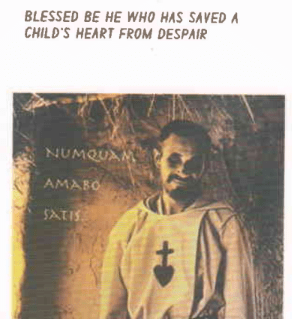
Our daughter Isabella put a memorial holy card together for this occasion, and we publish it here as a photo because it tells a whole story in itself. It depicts the image of a great saint, St. Charles de Foucauld (d. 1916), whom my husband had long admired, especially after a religious had shown him a room filled with photos of Charles de Foucauld who showed his transformation from a decadent and womanizing officer to an ascetic priest living in the desert trying to convert Muslims.
On the day when Charles de Foucauld was killed by some raiding Muslims, he wrote a letter quoting his own mentor and confessor, Father Henri Huvelin, who had said on his deathbed, in Latin: “Numquam amabo satis.” “I will never love enough.”
My own husband, Robert, was so touched by that quote that, in the last weeks of his own life here on earth, he discussed this Latin quote with several of his interlocutors, among them a former student of his from Christendom College and our pastor, Father Carlisle. Having been stirred to reflections himself by that quote and conversation, Father Carlisle then made a picture of the saint with that Latin quote, to be hung in his own office. One day, he came for a pastoral visit and showed this image to a visibly touched Robert Hickson. But not only this. When Robert had passed and was lying in his casket on the day of his wake, Father kindly brought that very framed picture with him and laid it on the casket, right above Robert’s head and heart. Father then later gave it to us as a grieving family.
So in order to remember that whole circle of a quote from a saintly priest that was written down by a saint and that was later cherished by an honorable Catholic layman in his last weeks of life, and then again by a saintly priest, our Isabella placed that very picture that Father had made onto our holy card in remembrance of today, also as a sign of gratitude for Father’s pastoral care and love for our family in difficult times. Our readers can read here a short, stirring account of Saint Charles de Foucauld’s life and that Latin quote.
Numquam amabo satis.
As if in God’s beautiful Providence, that was not yet enough, Robert actually had another conversation, the last deep and more intellectual conversation here on earth, with another priest who brought him in the last weeks of his life the sacraments. They spoke about Our Lady, whom our Robert loved so much. And Father brought up to Robert the quote “De Maria, numquam satis.” “Concerning Mary, never enough.” This statement written by St. Bernard of Clairvaux was later picked up by St. Louis Marie de Monfort and brought into a clarifying light with his commentary: “And yet in truth we must still say with the saints: De Maria numquam satis: We have still not praised, exalted, honored, loved and served Mary adequately. She is worthy of even more praise, respect, love and service.”
The priest later sent me a text message with that quote, saying that Robert had asked him to send me that quote because he loved it so much.
What a beautiful summary of a man’s life, what a fruit of a life of faith these two Latin quotes are! They seem like the peak of a mountain in a life that we all are to climb: at the end stands love, love of God and His Blessed Mother, and love of man. We can never love enough.
Yet here comes another lovely aspect to the story.
On top of that image of St. Charles de Foucauld on the holy card our daughter placed a quote from a French author, George Bernanos, and that quote itself has a deep meaning for our family, as well. The quote says: “Blessed be he who has saved a child’s heart from despair.”
Robert loved that quote so much that he wanted it to be on his tombstone. And so it will be, in only a few weeks, on his grave in the cemetery of the St. Thomas Aquinas Seminary of the Society of St. Pius X in Dillwyn, Virginia.
After his passing, Loreto Publications published a final collection of Robert’s essays. The book, entitled Ordo Dei: Collected Essays by Robert Hickson, contains all of his essays that he ever published on this website, Ordodei.net. And when we held the book in our hands, we realized that Robert’s last essay published by him here on earth dealt exactly with that very quote from George Bernanos!
We were also touched to see that the first essay on this website – and thus also in the book – was an essay about his most favorite author, Hilaire Belloc, entitled “Sentimentalists and Barbarians – Contrasting Thoughts of Hilaire Belloc in 1912 and G.K. Chesterton in 1934.” We can only recommend our readers to look it up.
The introduction to this last collection of essays – several other essay books had been previously published by Loreto Publications, one of them with a preface by Archbishop Carlo Maria Vigano – was written by Brother Andre Marie, M.I.C.M. We will end this this short commemoration of our beloved Robert Hickson with some quotes from Brother’s introduction, and our attentive readers will notice that, here, too, a circle is closing:
Dr. Robert Hickson loved words. Those of us who knew him can vouch for this fact. Yet, Robert was not a man who loved words more than that thing which it is the purpose of words to convey: the truth. A classicist who studied and taught Greek and Latin letters, Robert relished the words attributed to Saint Bernard of Clairvaux: Cui sapiunt omnia prout sunt, hic est vere sapiens (“He is truly wise who savors all things just as they are.”) He would point out that the Latin word for wisdom has for its root—as can be seen in this very passage from Saint Bernard—the verb, sapere “to relish.” [….]
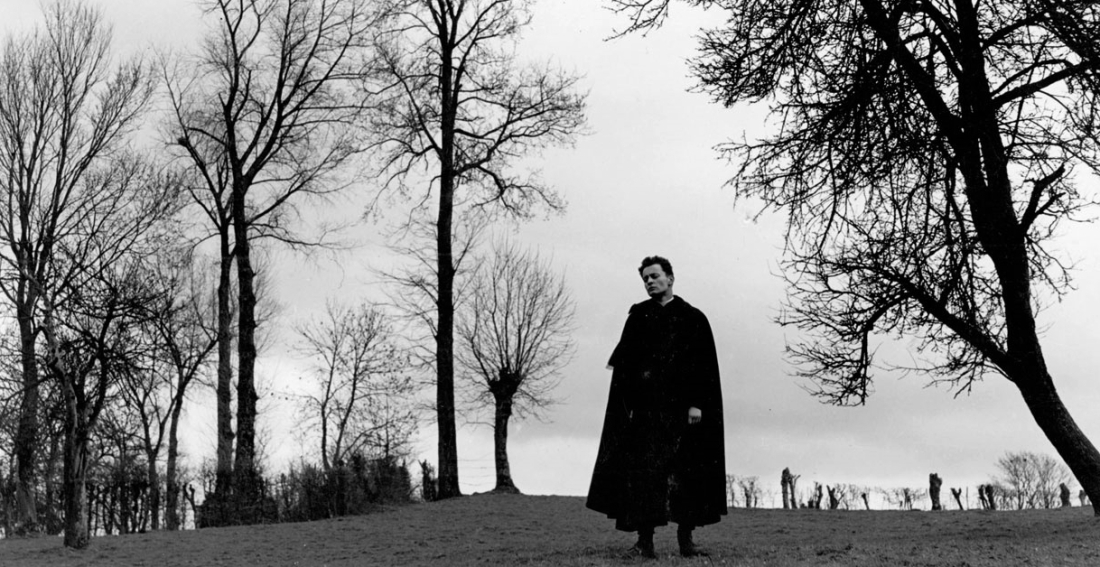
Robert would examine the mystery that lay behind such words as the calamitous “power without grace” that Evelyn Waugh put on the lips of Saint Helena, or the lovely “fresh supernatural Beatitude” that George Bernanos puts in the mouth of the eponymous curé in his Diary of a Country Priest: “Blessed be he who has saved a child’s heart from despair,” words Robert could rarely say without becoming emotional (and which, I am given to understand, will grace his headstone in Dillwyn, Virginia).
We thank God for Robert.
We miss you very much, Robert.
May you rest in peace. Requiescat in pace.
 Ordo Dei